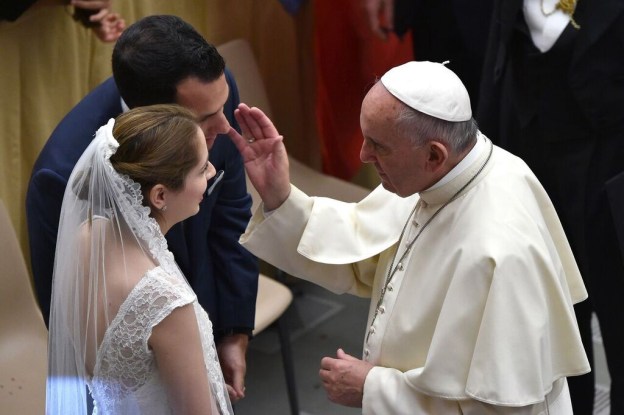
From a very early age I thought that I was destined to be a priest . Then something extraordinary happened to prevent my ordination. I fell in Love. It seems so strange to me that I was denied the opportunity to be ordained because of Love when after all it was because of Love that I wanted to be ordained in the first place. I Love Jesus … I fell in Love with Him when I was a child . He was my childhood hero. I Loved how he Loved the poor and destitute . I Loved how he came to serve rather than to conquer. I Loved that he was prepared to suffer unimaginable pain and suffering during His crucifixion simply because He Loved all of us. I Loved Him enough to offer my life through the priesthood in the hope that I could resonate His Love into the hearts of others that they too may come to know His unconditional Love for them. Then I fell in Love and married my Love and my dreams of becoming a Catholic Priest ended. Or so I thought !
If there is one ray of light coming from the ‘Synod on Schysm’ that the Synod on Synodality has become it is that amidst the razor sharp battle lines that have been drawn between so called Traditionalists and Modernists around the ordination of women, the LGBTQ+ community , the blessing of same sex unions and communion for the divorced there have been relatively few missiles exploding around the call for the ordination of married men.
Of course this issue shouldn’t really be that contentious. Married clergy , including Popes , have been a feature of the Catholic Church since the Apostles :
“It is clear from the New Testament (Mk 1:29-31; Mt 8:14-15; Lk 4:38-39; 1 Tim 3:2, 12; Tit 1:6) that at least the Apostle Peter had been married, and that bishops, presbyters and deacons of the Primitive Church were often family men. It is also clear from epigraphy, the testimony of the Fathers, synodal legislation, papal decretals and other sources that in the following centuries, a married clergy, in greater or lesser numbers was a normal feature of the life of the Church. Even married popes are known to us.“
“Priestly celibacy in patristics and in the history of the Church“). Roman Cholij, Secretary of the Apostolic Exarch for Ukrainian Catholics in Great Britain
There are also score of married clergy with families who entered into the Roman Catholic Church due to Pope Benedict XVI’s 2009 apostolic constitution Anglicanorum Coetibus. The constitution authorized the creation of “ordinariates,” geographic regions similar to dioceses but typically national in scope. Parishes in these ordinariates are to be Catholic yet retain elements of the Anglican heritage and liturgical practices. They are to be led by an “ordinary,” who will have a role similar to a bishop, but who may be either a bishop or a priest. The first such Ordinariate, Our Lady of Walsingham, was established in the United Kingdom in 2011 and was closely followed in 2012 by its American/Canadian counterpart ‘The Ordinariate of the Chair of Saint Peter’ . Based in Houston, Texas, this Ordinariate has more than 40 Roman Catholic parishes and communities across the United States and Canada. These Ordinariates facilitate the transition of former Anglican clergy who may be married with families into full communion with the Catholic Church.
The celibate priesthood has been a tradition since the 11th century, imposed in part for financial reasons to ensure priests’ assets pass to the church and not to their heirs. In the early church, Catholic priests were married.
They held services in their homes. Over time, power became rooted in Rome. Tithes were required from all “churches” and Catholic communities. A significant portion was, according to the customs of the times, produce from the priest’s lands: grain, meat, vegetables.
Another custom in effect was division of property at the death of the head of house. In some areas, lands were divided among all the father’s children. As not all the children were priests, the distribution of lands diminished the tithes the Pope received.
The practice of ordaining only unmarried men began in the 11th century, but did not formally become Canon law until the 20th century (1917).
The current Vatican policy is that marriage for priests could be reinstated Married priests are permitted in some eastern Catholic churches as well as where married Anglican priests have converted.
The Second Lateran Council (1139) made celibacy mandatory for future priests in the Western Church. In the last 40 years the Catholic Church has allowed some married, Protestant ministers to be ordained priests after they became Catholics.
CV NEWS FEED // German Bishop Franz Josef Overbeck said if the Catholic Church is going to continue to exist in Germany, the Church may have to allow priests to marry and to consider women’s ordination.
At a press conference for the Synod on Synodality over the weekend, Overbeck said Germany has a clergy crisis. In 13 years serving as the bishop of the Diocese of Essen, he said he has buried 300 priests and ordained only 15 seminarians. There are currently no seminarians in the diocese.
To address the shortage of priests, Overbeck intimated the German Catholic Church may have to look to the “Orthodox and eastern churches,” which allow priests to marry.
“How can we save the sacramental life of the Church? We must have priests and deacons,” he said. “Married priests are something normal in other religious traditions. Perhaps we will have to have a different answer at some point. Our situation is currently very difficult in [Germany].”
The farcical nature of Catholic doctrine on the ordination of married priests was brought into sharp focus in the UK in 2014 in the Archdiocese of Birmingham when Fr. Philip Gay who had served for 25 years as the parish priest of St Thomas More, Coventry made the fatal mistake of falling in Love with a Parishioner and was obliged to retire from the priesthood to marry the woman he had come to Love. He was replaced by a married priest with three children . The new priest was a former Anglican who had joined the Catholic Communion through the Ordinariate of Our Lady of Walsingham.
I could not understand why Traditionalists within the church had not been more vocal in their opposition to married Anglican priests with families being so warmly welcomed into the Church when it was these same Traditionalists who were incessant in their campaigns to prevent Roman Catholic married men from becoming priests. The answer is that the new ecclesiastical structures announced within Anglicanorum Coetibus were formulated to attract Anglicans who were opposed to the ordination of women, greater inclusion of the LGBTQ+ community , and the blessing of same-sex unions. In short, people just like them.
The document approved by the bishops noted that people of Catholic faith in the region have “enormous difficulties” in receiving communion and seeing a priest. It proposed to “ordain priests suitable and esteemed men of the community”, who had already had “fruitful” experiences as deacons and who “receive an adequate formation for the priesthood, having a legitimately constituted and stable family”.
Reformers say the change is crucial to meet the needs of the pan-Amazonian region but acknowledge it could lead to similar reforms elsewhere. Shortages of priests are so bad that some Amazon communities go months without a proper mass.
Now that married priests are so firmly established in the Church and so warmly embraced by a traditionalist wing who see them as significant allies in their war against the reforms called for across the globe within the Diocesan phase of the Synod on Synodality it has become increasingly hypocritical for them to continue to defy the god given right of Catholic married men to be ordained, in the footsteps of St Peter. The fact that they are so vocal in their fierce opposition to the Ordination of women, the LGBTQ+ community, same sex marriage and Communion for the divorced and yet quiet about the ordination of married men suggests to me that they are prepared to tolerate it if it means they get their way on all of the other big ticket issues. So there is hope for me still !
And if the Synod on Synodality results in the ordination of married men to the priesthood I will seek ordination and, with my beloved wife and child, I will focus the rest of my life on radiating Christs Love for his children, campaigning for the ordination of women, welcoming the LGBTQ+ community to share in Jesus’ unconditional Love for them, celebrating communion with the divorced and by blessing same sex marriages which are loving , faithful and committed.
And if the Synod kicks over ‘the Empty Chair ‘ ignores the Holy Spirit and rules against ordaining married men why should married Catholics with a priestly vocation worry when we can simply become an Anglican , transfer to one of the Ordinariates and become a Roman Catholic married priest that way . Job done !
Peace and Love
The Lay Pope
“I may speak in tongues of men or of angels but if I am without Love I am a sounding gong or a clanging cymbal. I may have the gift of prophesy and know every hidden truth; I may have Faith strong enough to move mountains but if I have no Love I am nothing. I may dole out all I possess or even give my body to be burnt but if I have no Love I am none the better. Love is patient; Love is kind and envies no one. Love is never boastful nor conceited nor rude; never selfish, not quick to take offence. Love takes no score of wrongs; does not gloat over others men’s sins but delights in the Truth. There is nothing Love cannot face; there is no limit to its Faith, its Hope and its Endurance.”
1 Corinthians 13: 1-7
 Manifesto for a Lay Pope